


Hundreds of people from various groups yesterday vented their ire toward President Ma Ying-jeou (馬英九) and his Chinese Nationalist Party (KMT) outside the party’s 19th national congress in Greater Taichung’s Wuci District (梧棲), by chanting slogans and throwing shoes.
Members of the Alliance of Referendum for Taiwan and the 908 Taiwan Republic Campaign shouted: “Step down, Ma” and “No to the service trade pact,” as they hurled shoes over police barricades toward convoys carrying the president and other high-ranking government officials when the vehicles arrived at the Taichung Stadium where the meeting began at about 8am yesterday. None of the shoes hit the vehicles as the protesters were barred dozens of meters away from the entrance.
Labor rights activist groups, including the National Alliance for Workers of Closed Factories (NAWCF) and the Taiwan International Workers’ Association (TIWA), joined the demonstration from Taipei at about 10:30am, bringing more than 10,000 pairs of shoes.
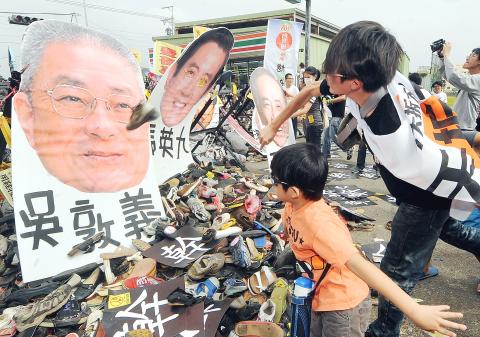
Photo: Liao Chen-huei, Taipei Times
“We’ve collected the shoes from Taipei, Taoyuan, Hsinchu, Miaoli, and Greater Taichung, and each pair signifies the public’s discontent with Ma and his government,” TIWA researcher Wuo Young-ie (吳永毅) told the crowd. “Hence, we are throwing the shoes at Ma not only because we’re upset about his performance, we’re doing it also to show him the true public opinion — this is to remind him what 90 percent of the people think of his government at a time when his approval rating is only 9.2 percent.”
Chanting: “Return our rights to us” and “We’re voting with our shoes,” protesters hurled hundreds of pairs of shoes over police barricades.
When the police were preparing to declare the actions illegal, Wuo spoke up to shoulder the responsibility.
“If you [the police] want to declare our protest illegal and ask us to disband immediately, go ahead and do it, I don’t care,” Wuo said. “Taoyuan Confederation of Trade Unions member Yao Kuang-chu (姚光祖) and I will take full legal responsibility for this, leave the others alone.”
Although the police reacted calmly to the protests, two incidents have intensified the situation.
The first occurred at about 11am when the labor rights groups were marching toward the venue, and a truck leading the parade sped up suddenly, with the driver shouting: “Taiwan belongs to the Taiwanese, this is our land.”
Police officers and NAWCF volunteer peacekeepers quickly rushed to the scene, and police stopped the truck by opening the door on the driver’s side and taking control of the steering wheel, while NAWCF volunteers stood in front of the vehicle.
The second incident involved pro-independence protesters shooting fireworks toward the gymnasium, with one exploding outside the press center on the second floor.
Police officers rushed to the scene to stop them from setting off more fireworks and later arrested an elderly lady who held a bag of fireworks in her hand, although she was not seen lighting any of them.
As the lady was taken into an elementary school nearby, a crowd gathered outside, calling on the police to release her immediately and engaging in physical clashes with officers.
After about 10 minutes, the police released the lady.
The groups spelled the English word “bumbler” on the ground with the remaining shoes before they left.
According to Deputy Minister of the Interior Hsiao Chia-chi (蕭家淇), a total of 1,200 police officers from across the country were deployed and more than 500 barbed-wire barricades used to make sure the meeting would proceed smoothly.

The National Chungshan Institute of Science and Technology yesterday showcased its locally developed variants of the Vision 60 robotic patrol dog, which it plans to deploy on the nation’s outlying territories in the South China Sea. The variants were produced under the Joint Lab project — created by the institute and domestic companies — and assembled with domestically produced motors, lenses and artificial intelligence (AI) systems alongside licensed tech from the US, Missile and Rocket Systems Research Division deputy director Jen Kuo-kang (任國光) told the media event at a military base in Taipei’s Dazhi (大直) area. Taiwan has built up its strengths

RIGHT DIRECTION: Taiwan’s efforts to prevent forced labor include a proposal to ‘fully prohibit’ employers from withholding workers’ documents, an official said Taiwan is to establish a mechanism to restrict imports of goods linked to forced labor, the Executive Yuan said yesterday, after the US proposed imposing additional tariffs on Taiwanese goods over labor concerns. “The Ministry of Labor and the Ministry of Economic Affairs are to establish an interministerial review procedure,” Executive Yuan spokesperson Michelle Lee (李慧芝) said at a news briefing in Taipei. “The government is to use the Foreign Trade Act [貿易法] as the legal basis to restrict imports of goods produced with forced labor” and bring its supply chain governance more in line with international standards on human rights, resilience

NOT IMMEDIATE: Taiwan has a chance to appeal the proposed 10 percent tariff before it starts, while other countries face a 12.5 percent tariff from the trade office Taiwan is among 60 economies determined by the US to have failed to impose or enforce a ban on the importation of goods produced with forced labor, according to a notice released on Tuesday by the Office of the US Trade Representative (USTR), which proposed imposing an additional 10 percent or more tariff on them. The USTR in a statement said that following an investigation, it had determined under Section 301 of the Trade Act of 1974 that the failure of the 60 economies to impose and effectively enforce a prohibition on the importation of goods produced with forced labor is

TIT-FOR-TAT: The US allegedly revoked the visa of a Chinese national working at Xinhua News Agency in the US in response to Beijing’s expulsion of Vivian Wang The Presidential Office yesterday condemned China for expelling a New York Times correspondent from Beijing following the newspaper’s interview with President William Lai (賴清德), saying the move highlighted Beijing’s suppression of press freedom and its threat to international news media. Taiwan has noted a series of recent incidents in which Beijing used similar tactics to “threaten and pressure international media outlets and journalists,” Presidential Office spokeswoman Karen Kuo (郭雅慧) said in a statement. “This concerns not only press freedom and freedom of expression, but also the safety of journalists, and Taiwan and relevant partners are paying close attention to the situation,” she


 RSS
RSS